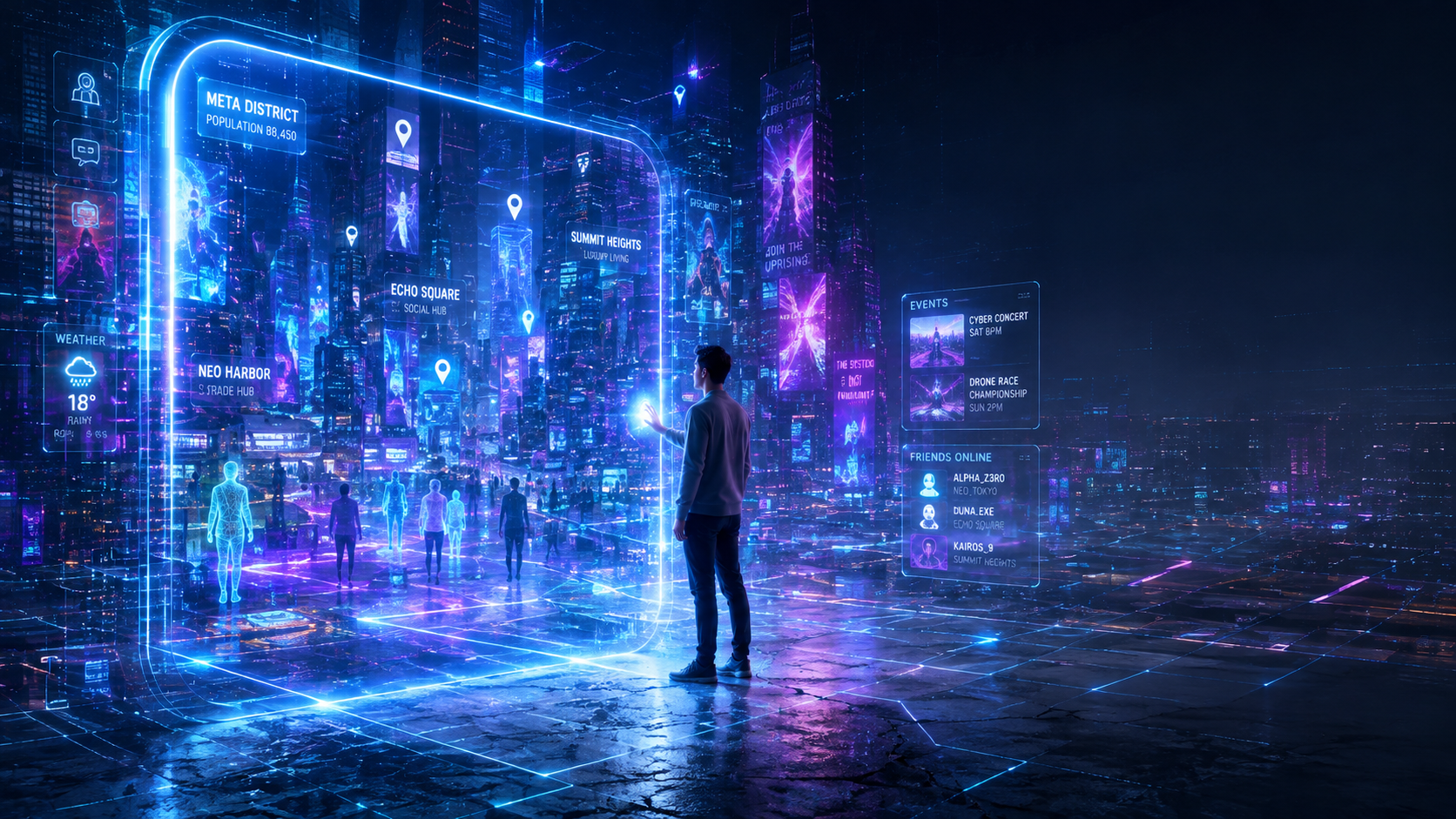
Teleportation should make geography irrelevant. In Decentraland, it did not.
Researchers who traced more than 251 million movements by 163,770 users found that people kept returning to a remarkably small set of places. Long-distance jumps were uncommon. A tiny share of virtual land captured almost all visitor activity. Even in a world where moving across the map takes a click, attention still collects around familiar and popular destinations.
That finding is a useful way into the metaverse because it separates technical possibility from human behavior. Better graphics, lighter clients and digital ownership can expand what a virtual world allows. They cannot give people a reason to care about it. To understand where the metaverse may be going, we need to examine both sides: the infrastructure that makes a world possible and the habits that make it inhabited.
What does “metaverse” actually mean?
There is no single metaverse and no settled technical specification for one. The most useful definition is a network of persistent, shared 3D environments in which people act through digital identities. Binance Academy's working definition adds four recurring characteristics: persistence, shared experience, immersion and interoperability.
Each term matters. Persistence means that the world and its state continue when an individual logs out. Shared experience means that participants can encounter one another and affect the same environment. Immersion creates a sense of space and presence, whether the screen is a headset, a phone or a laptop. Interoperability is the harder ambition: identities, assets or data should move between services instead of remaining trapped in one operator's database.
A headset is therefore optional. TechRepublic's overview includes ordinary computers alongside virtual and augmented reality devices. That broader view is practical. A virtual meeting room, an online game and a browser-based 3D shop can all use parts of the metaverse model without becoming sections of one connected universe.
It also helps to distinguish a metaverse from a conventional multiplayer game. Games can be persistent, social and economically active. A metaverse usually reaches for a wider range of identities and activities, with users moving between play, work, commerce and creation. Whether that wider scope is useful depends on the people inside it, not the label attached to the software.
The technology behind a persistent virtual world
The visible 3D scene is only the front end. Underneath it sits a collection of systems that have to agree about identity, state, ownership and time.
Access and rendering
The client turns scene data into the world a participant sees and hears. It may run as a native application, inside a web browser or through a headset. Local rendering gives the device most of the graphics work. Cloud rendering shifts that work to a remote server and streams the result as video. Both approaches trade hardware demands against bandwidth, latency and cost.
Easy access matters because every installer, account form and hardware requirement removes potential participants. It does not solve retention. A world that opens instantly can still be empty or forgettable.
Persistence and identity
A persistent world needs an authoritative record of what exists and what has changed. That record may live in ordinary databases, distributed systems, blockchains or a combination of them. It tracks positions, inventories, permissions, buildings, transactions and other shared state.
Identity is more than an avatar's appearance. It can include a name, social connections, reputation, access rights and possessions. Porting that identity to another world is difficult because software has to agree on both format and meaning. A sword model can be transferred as a file; its damage, rarity and legal ownership may make no sense in the destination. Genuine interoperability requires common standards and product-level agreements in addition to compatible file types.
Economies and digital ownership
A virtual economy does not require a blockchain. A central operator can issue items, keep balances and process trades in a database. As Binance Academy notes, blockchains become relevant when a project wants users to hold assets in their own wallets, inspect provenance, transfer value without the platform acting as custodian, or participate in on-chain governance.
Those properties carry costs. Users must protect keys. Public ledgers can expose patterns of activity. Smart contracts and bridges introduce security risks of their own. A blockchain can record who controls a token, but it cannot guarantee that another world will recognize the item, that a company will keep serving its media, or that the object will remain useful.
What 251 million movements reveal about virtual behavior
The strongest reality check comes from a 2026 study published in Scientific Reports. Kishore Vasan, Márton Karsai and Albert-László Barabási analyzed two periods of movement in Decentraland between March and September 2022. Their dataset covered 163,770 users and 251,643,262 movements. They also examined NFT purchases associated with users' pseudonymous wallets on Ethereum and Polygon.
The freedom to teleport did not produce wide exploration. A typical participant visited 18 land parcels, less than one percent of the available world. Users with NFT purchase histories explored more, averaging 39 parcels compared with 14 among other users, yet even the most active participant reached only 3.2 percent of the map.
Most movement remained local. Jumps of more than ten parcels accounted for 18 percent of movements. Users returned to a place they had visited before 90 percent of the time and spent more than half their time in only three to five locations.
Attention was even more concentrated than movement. The top one percent of Decentraland parcels attracted 94 percent of visitors. When people did explore somewhere new, popularity strongly influenced where they went. The researchers captured this tendency by extending an established model of human mobility so that popular destinations were more likely to be selected.
One result should interest anyone assigning value to virtual property: land price showed no meaningful relationship with visits in this dataset. Expensive parcels were not necessarily busy parcels, and proximity to a popular location did not reliably explain price. Market value and lived utility were measuring different things.
The study has clear limits. It examines one platform with a grid-based map, using activity from 2022. Its model does not fully represent three-dimensional movement, social ties, visual appeal or the activities available at each destination. The findings do not prove that every virtual world will develop the same pattern. They do show that removing physical distance does not remove familiar human tendencies.
Discovery and return visits matter more than virtual acreage
For builders, separating access from attention matters. A faster client can bring more people through the door. It cannot decide where they gather or whether they come back next week.
Popular destinations benefit from a feedback loop: visibility brings visitors, and visitor activity creates more visibility. Search, recommendations, event calendars, social presence indicators and portals therefore shape a virtual world's geography as strongly as roads shape a physical city. A discovery system that only promotes current winners may leave most of the map functionally invisible.
The Decentraland findings also suggest better ways to measure a world. Parcel sales and token prices reveal market activity, not necessarily use. Repeat visits, dwell time, distinct human participants, social interaction and completion of useful tasks say more about whether a place is becoming part of anyone's routine. A large map can be technically impressive while supporting only a handful of meaningful destinations.
This is why content and community cannot be postponed until after the infrastructure is built. People return for other people, changing activities, status, convenience or work they can accomplish. Persistence has value when something worth remembering persists.
Identity brings a privacy problem with it
Portable identity can reduce the need to rebuild a profile and reputation in every service. TechRepublic points to self-sovereign identity and zero-knowledge proofs as possible tools. In principle, a user could prove an attribute or permission without disclosing the underlying personal information.
The opposite outcome is also possible. The Scientific Reports researchers note that blockchain records are pseudonymous rather than fully anonymous and may enable deanonymization. If one identity accumulates purchases, movements, messages and social relationships across worlds, portability can become cross-platform surveillance.
Sensible design limits what must be public. Payment settlement, asset ownership and access credentials do not require every movement or conversation to be written to a permanent ledger. Selective disclosure, local processing and short data-retention periods should be architectural choices, not privacy language added after launch.
AZTEQ's browser-first approach
AZTEQ's One Metaverse offers a current test of several ideas in this article. CryptoFocus reported on its August 2026 launch as a virtual world that opens in a browser tab, without a native installer or an app-store gatekeeper.
In AZTEQ's 2026 whitepaper, the browser gateway is called Virtua. The document describes a WebGPU client that renders scenes on local graphics hardware from compact procedural parameters and WebAssembly modules instead of downloading finished 3D worlds. It specifies a 15 MB initial payload and sustained state synchronization below 5 Mbps, compared with a conventional 20 GB to 60 GB client. These are AZTEQ's figures and should be treated as design targets until performance is independently measured across devices, connections and complex scenes.
The architecture separates different jobs. According to the whitepaper, Bitcoin provides final settlement, Lightning handles rapid payments, Nostr carries identity and social messages, and a Move-based network called Avenge manages the state of digital objects. The “3-D Methodology” turns procedural creations into Dynamic Digital Assets, stores their changing attributes in 512 KB Data Keeping Units and distributes the parameters through regional edge infrastructure.
AZTEQ describes three connected environments. Life is a persistent open world with districts and land titles. Xolo is an arcade built around skill-based competition. Virtua doubles as a spatial workspace. An AI layer called Onyx is intended to give agents embodied avatars and memory across sessions.
The browser strategy addresses a real problem: entering many 3D worlds still demands a large download, current hardware and patience. It also leaves the harder problem intact. The Decentraland research suggests that limitless movement and abundant land will not distribute attention evenly. AZTEQ says venues in Life can receive rewards based on Nostr-verified footfall, which at least makes use visible in the economic design. The lasting test will be whether those venues give people enough value to return without being paid to do so.
How to evaluate a metaverse project
The term is broad enough to hide weak products. A few practical questions make it more useful:
- How difficult is entry? Check the download, account, hardware and payment requirements before judging a polished trailer.
- What persists? Identify which changes survive a session and who controls the authoritative record.
- Why would anyone return? Look for social ties, evolving activities or useful work rather than a large map alone.
- What does ownership permit? Separate custody of a token from the right and technical ability to use its associated object elsewhere.
- How is attention measured? Repeat visits and meaningful activity are stronger evidence of use than asset price by itself.
- What becomes public? Trace which identity, movement and transaction data can be linked over time.
The metaverse is likely to arrive in pieces
The metaverse is better understood as a direction for digital interfaces than as a finished destination. Browser graphics, immersive hardware, persistent games, creator tools, AI agents and cryptographic ownership are developing at different speeds. Some will connect. Others will remain useful without full interoperability.
The research on Decentraland offers a durable benchmark for all of them. Technical freedom does not produce human interest automatically. A virtual world becomes meaningful when people find places, activities and relationships worth returning to. Capability opens the door. Habit decides whether the world remains inhabited.