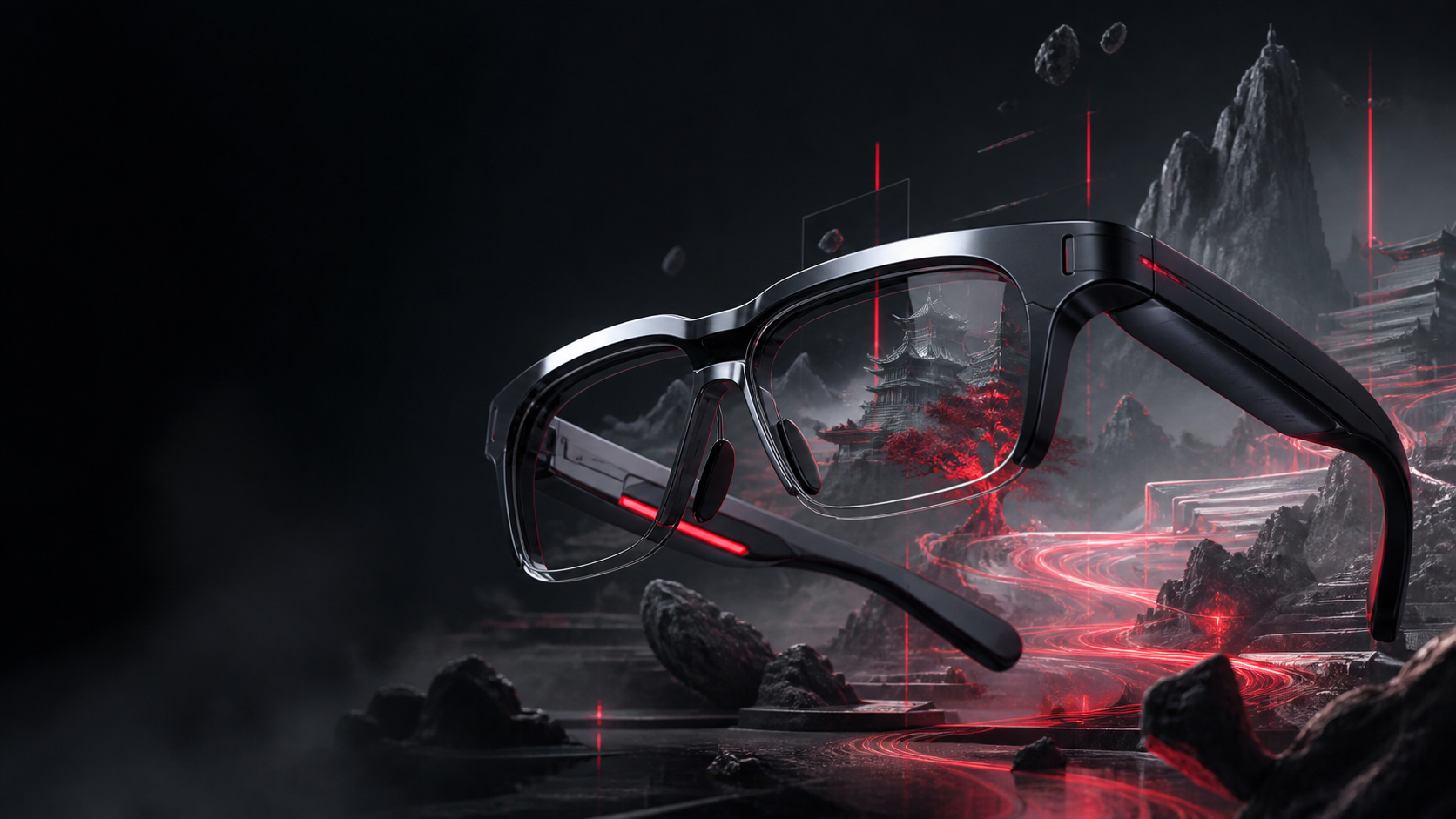
VITURE and S-GAME have made an unusual collector’s edition for Phantom Blade Zero. It is not a statue, an art book or a replica sword. It is a pair of XR display glasses.
Announced on 27 August, the Phantom Beast glasses cost $599 and are scheduled to ship on 29 October, the same day as the game. The product uses the display system from VITURE’s existing Beast glasses, then adds a Phantom Blade Zero exterior, a themed on-screen interface, a custom case, a detachable strap and physical collectibles.
That distinction is important. Phantom Beast is not a new technical generation disguised as a collaboration. Its value as a news story lies elsewhere. It tests whether immersive hardware can enter the mainstream through games and fan culture, rather than through another broad promise about “the future of computing”.
For years, XR companies have asked people to buy a device first and discover a reason to use it later. VITURE and S-GAME are reversing the order. The game supplies the desire. The hardware arrives as part of the world around it.
What VITURE and S-GAME actually launched
Phantom Beast is a limited themed edition of the VITURE Beast, a pair of glasses that acts as a private wearable display when connected to a compatible phone, handheld console, computer or other source device.
According to VITURE’s product page, the glasses use Sony micro-OLED displays with a resolution of 1200p per eye, a refresh rate of up to 120Hz and a 58-degree field of view. VITURE describes the result as equivalent to viewing a 174-inch screen from four metres away. That size comparison is a company claim, not a physical screen measurement.
The glasses also have built-in three-degrees-of-freedom tracking. In practice, that allows a virtual screen to remain anchored while the wearer turns or tilts their head. Electrochromic lenses can darken the view behind the display, and the product connects over USB-C. Console use may require extra hardware. VITURE’s announcement says PlayStation 5 support is available through its optional Pro Mobile Dock.
Most of the Phantom Beast changes are visual or experiential. Small blade-inspired details appear on the frame. The software menu uses imagery from the game. The case and included items extend the presentation beyond the glasses themselves. VITURE has also tied the launch date directly to Phantom Blade Zero, the dark wuxia action game that S-GAME is releasing for PlayStation 5.
The standard Beast has a listed price of $549, so the collaboration currently carries a $50 premium. Buyers are paying for the game-specific design and package, not a faster display or wider field of view.
Why a themed shell can still matter
Calling the product a reskin would be accurate but incomplete. Consumer technology does not succeed on specifications alone. People need a reason to notice it, understand it and imagine using it.
XR has struggled with that sequence. A general-purpose headset can demonstrate remarkable engineering while leaving the buyer with a basic question: what will I do with it every week? Games answer that question more effectively because they already have characters, communities, launch calendars and emotional investment.
Phantom Beast borrows a familiar habit from game publishing. Collector’s editions turn attachment to a fictional world into a physical purchase. The difference is that these glasses can remain useful after the credits roll. A buyer can connect them to another game, a film, a laptop or a handheld console. If that behaviour develops, a piece of merchandise becomes an entry point into a wider spatial-computing category.
This is the most interesting part of the launch. VITURE is not asking a new audience to care about XR in the abstract. It is placing XR beside a game that audience may already be waiting to play.
There is a precedent inside VITURE’s own strategy. The company previously released a Cyberpunk 2077 edition. It now describes the S-GAME partnership as its first with a Chinese game studio and its second collaboration around a major game franchise. Two editions do not establish a durable market, but they show a repeatable distribution idea: treat hardware as part of a game’s cultural release, not as a separate technology campaign.
These are display glasses, not a complete virtual world
The category needs careful language. Phantom Beast is not a standalone VR headset and it does not place fully interactive objects throughout a mapped room. It has no independent game processor, outward-facing spatial-mapping system or hand-tracking interface.
Its main job is simpler. It puts a large virtual screen in front of the wearer while another device runs the content. That narrower function may be an advantage. Setup can be closer to plugging in a monitor than entering a new operating system, and the frame is easier to carry than a conventional headset.
It still has friction. The glasses are wired to a source device. They are larger than ordinary eyewear. Some consoles need an adapter or dock. People who require prescription correction may need inserts because the Beast does not have built-in myopia adjustment.
Android Authority’s independent review of the standard Beast found the glasses comfortable and broadly compatible with devices that support video over USB-C. The reviewer liked the built-in screen anchoring and the experience for games and video, but found smaller text less clear, criticised the absence of myopia dials and was unconvinced by the software’s 2D-to-3D conversion. Those observations apply to the underlying Beast hardware, not specifically to the unreleased Phantom Beast package.
This is why the launch should not be read as proof that XR’s hardware problems are solved. It is evidence that companies are testing a more legible way to sell the hardware they already have.
What this says about the metaverse after the hype
The word “metaverse” appears less often in hardware launches than it did several years ago. The underlying work continues under labels such as XR, spatial computing, wearable displays and smart glasses.
Phantom Beast is relevant because it reduces the size of the promise. It does not ask someone to move their identity, work and social life into a new digital universe. It offers a portable screen for a game with a clear release date. That is a transaction people can evaluate.
Mass adoption may grow from many transactions of this kind. A person buys glasses for one game, then uses them for streaming. A browser-based world works on the laptop they already own, then becomes more immersive when a display is connected. A specialist device earns broader use one practical session at a time.
This also clarifies the value of a browser-first approach. AZTEQ is building One Metaverse around access through existing web hardware, while VITURE is trying to make dedicated hardware desirable through entertainment people already recognise. The routes start at opposite ends of the same problem. One lowers the cost of entry. The other gives an optional device a specific reason to exist.
The strongest spatial platforms will likely need both principles. Entry should be possible without a large download or specialist headset. Better hardware should deepen an experience without dividing users into disconnected versions of the same world.
The commercial test begins after launch day
VITURE and S-GAME have not disclosed preorder numbers. There is no public evidence yet that Phantom Blade Zero fans want a $599 wearable display, or that buyers will keep using it after the game’s launch period.
Four results would make this experiment more meaningful.
First, the edition needs to reach buyers who had not already planned to purchase VITURE glasses. Otherwise, the collaboration is serving an existing customer base rather than expanding the category.
Second, owners need to use the product regularly. Sell-through measures interest in a launch. Continued use shows whether the hardware has found a place in someone’s routine.
Third, the game-specific interface must improve the experience rather than merely decorate it. A custom menu is pleasant, but deeper integration could make settings, display modes or game information genuinely useful.
Finally, buyers need a smooth path beyond the original game. Compatibility, software support and accessories will decide whether Phantom Beast remains an expensive collectible or becomes a gateway to other content.
Those questions cannot be answered by a press release. They require usage data, customer feedback and time.
A more believable adoption story
Phantom Beast does not prove that XR glasses are about to become mainstream. It does show a more believable way to pursue that goal.
The launch begins with a game, a date and an audience. The product can be explained in one sentence: it is a private wearable screen designed around Phantom Blade Zero. From there, buyers can decide whether the larger promise is worth exploring.
That approach is more grounded than selling an empty platform and hoping communities arrive later. It respects a basic rule of technology adoption: people rarely change their behaviour for a category. They change it for an experience that feels useful, enjoyable or personally relevant.
The real story will not be the artwork on the frame. It will be what owners do once the novelty has worn off. If the game brings new users into XR and the glasses earn repeat use beyond it, VITURE will have found something more valuable than a collector’s edition. It will have found a bridge.