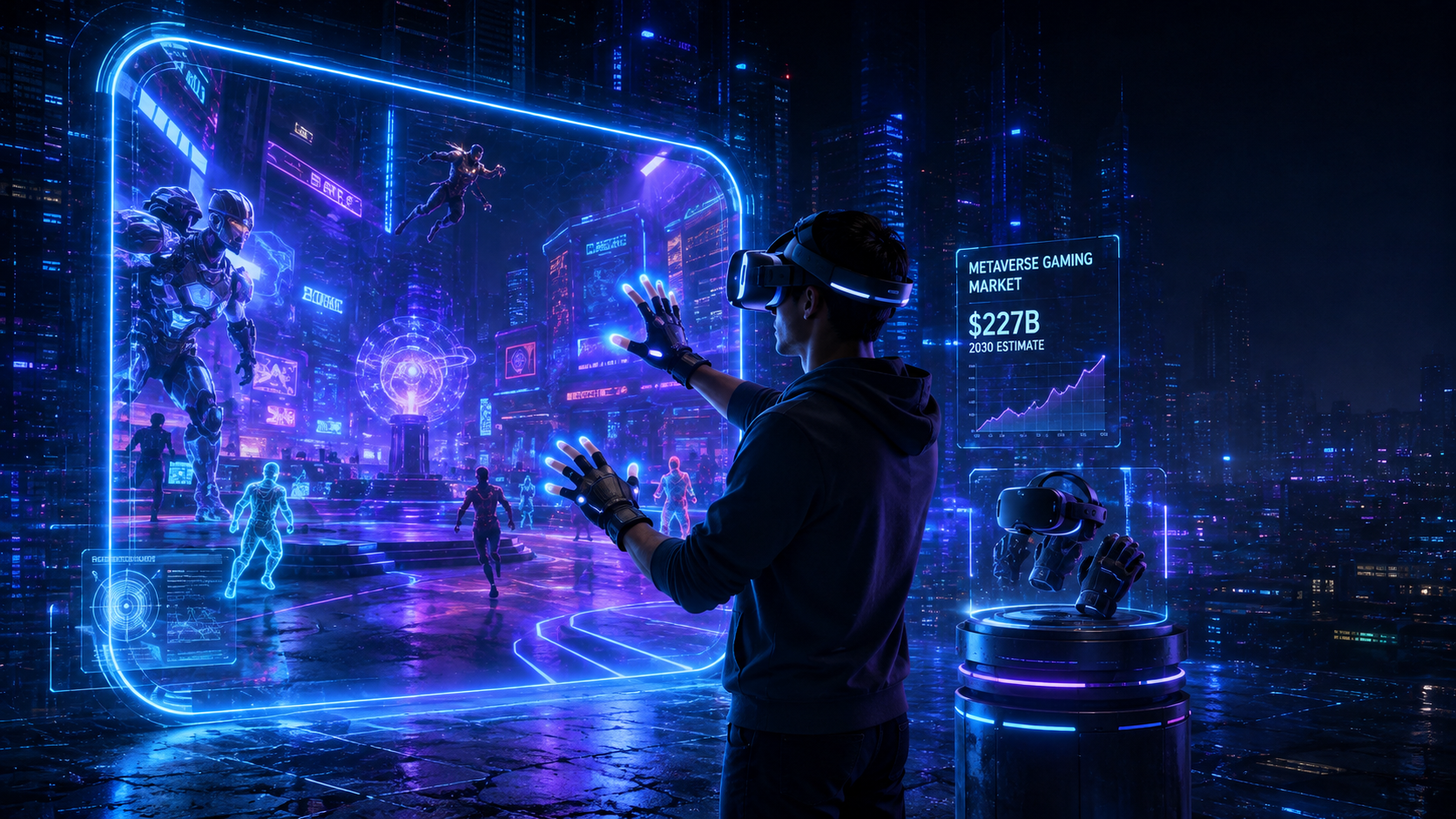
A $227 billion forecast makes an impressive headline. A figure of 4.1 million sounds modest beside it. Yet the smaller number may tell us more about where metaverse gaming is actually heading.
Market Research Future, in a forecast distributed through EIN Presswire, estimates that the metaverse gaming market will grow from $23.8 billion in 2025 to $227 billion in 2035. That works out to a compound annual growth rate of 25.3 percent from 2026 through 2035.
Meanwhile, Omdia expects shipments of displays for augmented-reality glasses to reach 4.1 million units in 2026, up 154 percent from a year earlier. It forecasts shipments of displays for virtual-reality headsets to fall 4 percent to 10.5 million.
The two sets of numbers measure different things. One models revenue across a broad market for the next decade. The other tracks components going into devices now. Read together, they point to a credible growth opportunity with an unresolved condition: the hardware still has to fit into ordinary life.
What a 25.3 percent growth forecast really means
A compound annual growth rate, or CAGR, is a smoothed path between a starting value and an ending value. It does not mean revenue will rise by exactly 25.3 percent every year. A market can accelerate, stall and contract along the way while still arriving at the forecast endpoint.
The $227 billion figure is therefore a scenario, not future revenue already waiting to be collected. Market Research Future starts with an estimated $23.8 billion in 2025 and $29.8 billion in 2026, then projects the market to 2035. Its scope includes revenue from metaverse gaming platforms, virtual economies, enabling hardware connected to those ecosystems and associated technology services. It is much broader than sales of headsets or games alone.
The report identifies cheaper spatial-computing hardware, better broadband, creator income, artificial intelligence and cloud rendering as growth drivers. Those assumptions are reasonable, but each one has to materialise. Forecasts become less reliable as the time horizon lengthens, especially in a market whose boundaries are still debated.
The useful question is not whether $227 billion is the correct number to the last decimal place. It is what would have to become true for growth on that scale to occur.
The hardware data shows where the pressure sits
Omdia's current near-eye display forecast expects total revenue in that component market to rise 12 percent to $675 million in 2026. Shipments are forecast to increase 16 percent to 14.53 million units.
The recovery is uneven. AR display shipments are expected to rise 154 percent to 4.1 million units, while AR display revenue is forecast to climb 152 percent to $156 million. VR display shipments are expected to fall 4 percent to 10.5 million, with revenue also down 4 percent at $518.7 million.
Display shipments are not the same as device sales, and neither figure measures metaverse participation. Their direction is still informative. Omdia says large technology companies have delayed or reduced some VR headset plans while giving more attention to lightweight AI and AR glasses.
A separate Omdia forecast for XR headwear reinforces that shift. It expects total XR headwear shipments to fall 12 percent to 6.2 million units in 2026, then return to modest growth in 2027 as glasses offset continued weakness in headsets. Standalone XR headset shipments are forecast to decline 15 percent to 4.7 million in 2026, the fifth consecutive annual contraction from the category's pandemic peak. Tethered XR glasses, by contrast, are projected to grow from 900,000 units this year to 3.8 million in 2030.
The obstacles are familiar: weight, heat, power consumption, price and a shortage of reasons to wear a device for long periods. Better displays help, but display quality cannot make a heavy headset disappear from the user's face.
AR is becoming more important than the old VR-only vision
Virtual reality shuts out most of the physical environment to create a more immersive space. Augmented reality places digital information within a view of the existing world. That difference changes how, where and for how long a device can be used.
VR remains suited to experiences that benefit from full immersion. AR glasses can serve shorter and more frequent sessions while leaving the wearer connected to the room, street or people around them. That makes the form factor relevant to gaming, but also to navigation, communication, work and media.
OLED-Info's summary of Omdia's longer-range outlook puts AR display shipments at 21 million units in 2030, ahead of 19 million for VR. It also says AR's share of the combined display market could rise from 28 percent in 2024 to 57 percent in 2032. These remain forecasts, but the direction matches the product decisions Omdia is seeing today.
That does not make VR obsolete. It suggests that the metaverse may reach a larger audience through several kinds of screen, with lightweight glasses taking more of the role once assigned almost entirely to enclosed headsets.
Oculus Go is a useful warning from 2017
The hardware industry has tried to remove entry barriers before. In October 2017, Mashable reported Facebook's announcement of the $199 Oculus Go, a standalone headset that did not need a gaming computer.
The pitch was straightforward: lower the price, remove cables and make VR easier to try. Facebook discontinued the product less than three years after the announcement. TechCrunch reported in June 2020 that the entry-level opportunity had proved too small to hold developer interest, while more capable devices such as the Quest offered a stronger path forward.
Oculus Go did not prove that affordable VR cannot work. It showed that price is only one constraint. Processing power, tracking, comfort, software and developer economics decide whether a cheaper device becomes a lasting platform or a short-lived bridge to the next one.
That lesson matters when reading today's market projections. Adoption does not arrive because a category becomes less expensive in isolation. The complete experience has to become good enough for people to return.
Gaming can lead, provided the experience earns attention
Gaming remains a logical entry point for metaverse technology. Players already understand persistent identities, shared worlds, virtual goods, live events and user-created content. Developers know how to build progression, communities and reasons to come back.
Those habits matter more than the label. A product described as a metaverse still competes with every game, social network and streaming service for the same hours in a person's day. A headset can deepen presence, but it also adds a purchase decision, setup time and physical friction.
For the market to approach the scale in Market Research Future's forecast, access will have to widen beyond dedicated XR hardware. Browsers, phones, computers, consoles and glasses can all become entry points. Users should be able to begin with hardware they already own and choose greater immersion when it improves the experience.
The economics must work as well. Creators need a practical route to build and earn. Players need clear value for their time and money. Platforms need enough activity to support infrastructure without turning every interaction into a transaction. None of those outcomes follows automatically from faster graphics or a token model.
Why AZTEQ's browser-first approach fits this shift
AZTEQ is making a relevant access bet. CryptoFocus reported on the August 2026 launch of One Metaverse, which opens through a web browser rather than requiring a native installer.
In AZTEQ's 2026 whitepaper, the Virtua client is designed to use WebGPU and WebAssembly so a user's own graphics hardware can render a world from compact instructions. The document specifies an initial payload of 15 megabytes and continuing state synchronisation below 5 megabits per second, compared with a conventional client download of 20 to 60 gigabytes. These are project figures and still need independent testing across devices, networks and demanding scenes.
The strategic logic is sound. Browser access allows people to enter before they decide whether specialised hardware is worth buying. If lightweight glasses become common, they can add another way to experience the same world. If headset demand remains weak, the browser route still exists.
This design does not solve the hardest product question. One Metaverse, like every virtual world, must give people a reason to return after the first visit. Low friction gets a user through the door. Content, community and utility determine whether that door stays busy.
The market can grow while the hardware mix changes
The $227 billion forecast and the current shipment data are not contradictory. Metaverse gaming revenue could expand rapidly even if bulky headsets remain a specialist category. Growth may come through mobile access, browsers, cloud rendering, lightweight glasses, creator tools and digital economies as much as through traditional VR.
For investors, developers and participants, current behaviour deserves more weight than a distant endpoint. Vendors are shifting attention toward devices that are easier to wear. VR headset shipments remain under pressure. Browser-based platforms are trying to remove installation and hardware barriers altogether.
The metaverse gaming opportunity is real enough to study and uncertain enough to question. A decade-long CAGR cannot supply comfortable hardware, useful worlds or repeat users. The projects best placed to benefit will let people enter first and upgrade the experience later.