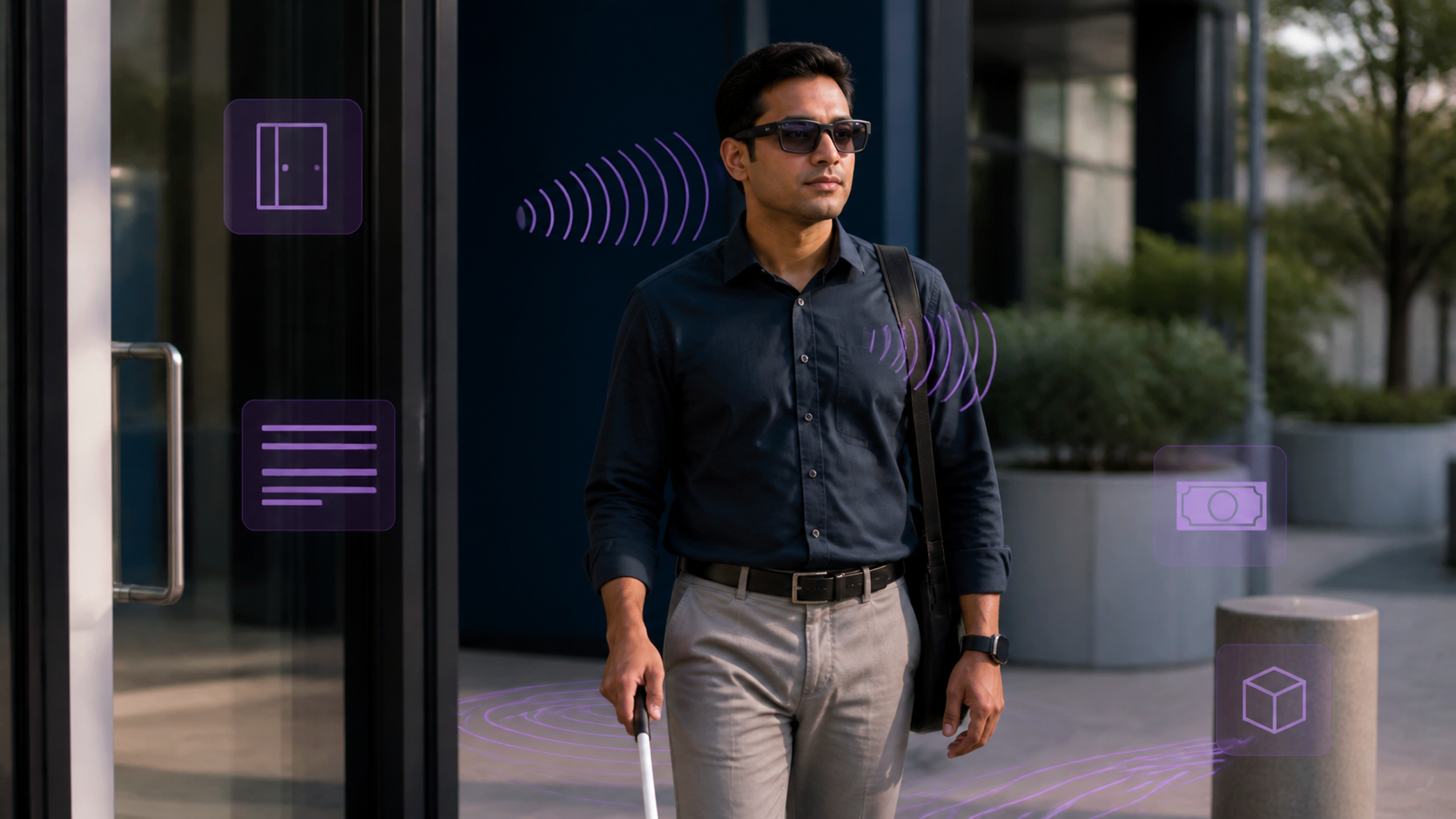
Smart glasses are usually demonstrated as a convenience. Take a photograph without reaching for a phone. Ask an AI assistant what is in front of you. Hear directions through speakers built into the frame.
For a blind user, that same combination of camera, software and audio can address a different class of problem. It can read a printed page, identify a banknote, describe an object or warn that something is blocking a path. The value is measured in tasks completed with less assistance, not in the novelty of wearing a computer.
That is why a report from Bengaluru deserves attention beyond the accessibility sector. Reporting republished by Mangalore Today on 26 August says the Association of People with Disability has provided 25 smart glasses to blind staff across three centres and plans to distribute another 150 by the end of 2026. The report also records an unresolved divide between devices that perform some work locally and those that depend more heavily on cloud services.
AZTEQ has not independently confirmed the distribution figures or timetable with APD, so they should be treated as attributed figures rather than proof of a completed rollout. The deployment is still useful as a case study. It puts wearable AI in ordinary workplaces, where accuracy, connectivity, privacy, training and support matter at the same time.
What happened in Bengaluru
The Bengaluru report describes several products in use, including consumer smart glasses and devices built specifically for people who are blind or have low vision. It says donor-funded organisations have been distributing these tools for about two years. APD's planned expansion is the freshest sign that the category may be moving from demonstrations towards repeated daily use.
APD is not a technology retailer. It is a disability organisation founded in 1959 whose programmes include rehabilitation, employment and assistive technology. The organisation says it has distributed more than 69,000 assistive devices and mobility aids across its wider work. That background matters because handing someone a device is only one part of access. Assessment, training, maintenance and follow-up determine whether it becomes useful after the first week.
The reported numbers are modest. Twenty-five devices do not establish mass adoption, and 150 more remain a plan. They do, however, create a better test than a controlled product demo. Staff can find out whether the glasses remain comfortable, accurate and dependable across real tasks, languages and network conditions.
What these glasses actually do
Assistive smart glasses do not restore eyesight. SHG Technologies states this explicitly in its product guidance. The glasses use sensors and software to translate selected visual information into speech or alerts.
SHG's Smart Vision Glasses Ultra, one of the purpose-built products named in the report, combines a camera, microphones, open-ear speakers and a multi-zone LiDAR sensor. Its product page lists text reading, obstacle detection, scene description, currency recognition and recognition of familiar faces among its functions. The camera captures an image or video frame. Optical character recognition or a computer-vision model interprets it. The result is then spoken to the wearer.
This sounds simple because the interface is simple. The engineering problem is not. A useful system must decide what deserves attention, respond quickly and avoid flooding the user with descriptions. It must also handle poor lighting, crowded scenes, regional languages and objects it has not seen before. A confident but incorrect answer can create more risk than admitting uncertainty.
The glasses should therefore be understood as another tool in an accessibility toolkit. They can complement a white cane, screen reader, smartphone and mobility training. They are not a guaranteed replacement for any of them, especially in safety-critical navigation.
The decisive split is local processing versus the cloud
Two devices can look almost identical while handling data in very different ways.
Local, or edge, processing means the device or a connected phone performs the analysis nearby. It can keep basic functions available when a network fails, reduce response time and limit the amount of visual data sent elsewhere. Cloud processing gives a wearable access to larger models and more demanding functions, but an image, audio sample or extracted text may need to leave the user's device first.
SHG says its Ultra model can read text both online and offline. Its FAQ says most functions work offline, with exceptions that include face recognition and storage, and that offline reading is available in English, Hindi and Marathi. The associated Google Play data-safety declaration says the app collects no data, shares none with third parties and encrypts data in transit. Those entries are supplied by the developer, not independently audited guarantees.
The Jyoti accessibility app from Torchit makes a different disclosure. Its Google Play listing says the app may collect personal information as well as files and documents, while declaring that data is encrypted in transit, is not shared with third parties and can be deleted on request. The Bengaluru report quotes a Torchit representative saying data is stored in the company's cloud and used to train its models.
There is no reason to collapse these products into one privacy judgement. Buyers need to know which function runs where, what is uploaded, how long it remains available, whether it is used for model training and who can request deletion. “AI-powered” does not answer any of those questions.
On-device vision is becoming more capable. A July 2026 research paper on the ARGO smart-eyewear platform describes an optimised object-detection model running on a microcontroller with a neural processing unit. The work is a research prototype, not evidence that every commercial product can run every feature locally. It does show that privacy-preserving edge processing is an engineering direction, not a theoretical wish.
Accessibility does not cancel the privacy question
A wearable camera creates two legitimate interests at once. The wearer may depend on it to understand a shared space. Other people in that space may want to know when they are being captured and what happens to the data.
Treating either interest as absolute produces a poor result. A blanket ban on camera glasses can remove an accessibility tool from the people who benefit most. An invisible, always-on capture system can make colleagues and strangers feel monitored without a meaningful way to respond.
The better answer is product design backed by clear operating rules. Camera indicators must be visible enough for bystanders to notice. The wearer needs an accessible way to know when capture is active. Local processing should be the default where it can perform the task. Cloud features should explain what they send before the user enables them. Retention periods, training use and deletion controls should be stated in plain language.
Workplaces also need a policy that distinguishes visual assistance from recording for publication or surveillance. The policy should be written with blind users, not merely imposed on them. APD's own principle, “Nothing about us, without us”, is a sound starting point for that process.
Price is only the first access barrier
The Bengaluru report places prices for the category at ₹29,000 and above. Current direct retail pricing varies by model. SHG's online store lists the 2026 Ultra at ₹50,400 including tax.
Donor funding can put early devices into users' hands, but sustainable access requires a fuller calculation. Who pays for replacement frames, batteries, repairs or mobile data? How quickly can a broken device be serviced? Does training cover every language and feature? Can an employer support the tool without gaining unnecessary access to usage information?
These questions are less exciting than a product launch. They decide whether the product remains in a drawer or becomes part of someone's working day.
The strongest programmes will measure outcomes rather than the number of boxes distributed. Useful measures could include how often the glasses are used after three or six months, which tasks users choose them for, where errors occur, how much training is required and whether users feel more control over their work. Those results would tell the market more than shipment figures alone.
Why this matters to spatial computing
Spatial computing is often associated with three-dimensional graphics placed over the physical world. This use case starts one layer earlier. The system must perceive a space, identify what is relevant and return information at the moment a person can act on it.
For blind users, the output may be audio instead of an image floating inside a lens. The underlying challenge is still spatial: understand the relationship between a person, an object and the surrounding environment without demanding constant attention to a phone screen.
That gives metaverse and wearable-computing projects a more demanding adoption standard. A device earns a place when it removes friction from a recurring task. The quality of the experience depends on latency, accuracy, privacy and control long before visual spectacle enters the discussion.
Developers should ask a few direct questions. Does the core function survive a lost connection? Can the user tell when the system is uncertain? Who owns an image of a shared space? What support exists after purchase? Can the user choose the language, amount of detail and processing mode? A product that cannot answer those questions is not ready to become ambient infrastructure.
The real test is what happens after the demonstration
The Bengaluru report does not establish that AI smart glasses have reached broad adoption. It documents something more useful at this stage: people applying the technology to work and daily life, while encountering the limits that launch videos tend to leave out.
The promise is easy to understand. A wearable can turn text, objects and parts of the surrounding environment into timely audio. The conditions for delivering that promise are harder. The system must work when connectivity is poor, describe uncertainty honestly, protect both wearer and bystander, and remain affordable and repairable.
If the planned APD expansion proceeds, its importance will lie in what users learn from sustained use. Their experience can show which features create independence, which merely sound impressive and where product design still transfers too much risk to the person wearing the glasses.
That is a valuable lesson for the wider spatial-computing market. The future will not be decided by how much technology fits inside a frame. It will be decided by whether that frame helps someone act with greater agency in the world around them.
Sources and further reading
Mangalore Today report
https://www.mangaloretoday.com/headlines/For-the-blind-smart-glasses-are-opening-a-new-world.html
Association of People with Disability
https://www.apd-india.org/
SHG Technologies FAQ
https://shgtechnologies.com/faq
Smart Vision Glasses Ultra
https://shgtechnologies.com/smart-vision-glasses-ultra-a-made-in-india-ai-powered-assistive-smart-glasses
Google Play: SVG Ultra
https://play.google.com/store/apps/details?id=in.shgtechnologies.svgultra
Google Play: Jyoti AI
https://play.google.com/store/apps/details?id=com.torchit.jyotiai
ARGO research paper
https://arxiv.org/abs/2607.16222
APD India: About us
https://www.apd-india.org/about-us/
SHG Ultra product listing
https://shgtechnologies.com/store/store-product/smart-vision-glasses-ultra