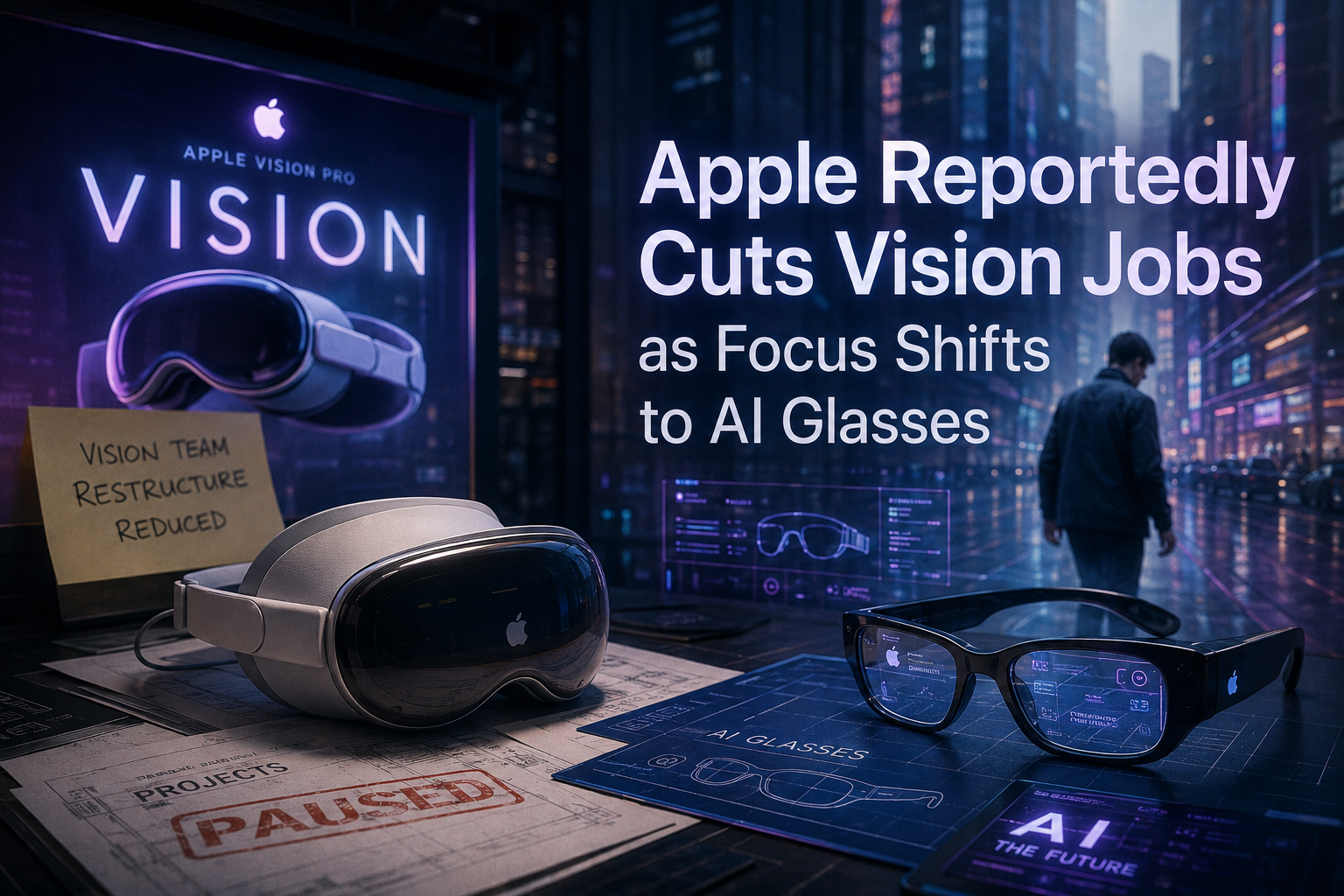
Apple's reported cuts inside the organisation behind Vision Pro are easy to read as a funeral notice for the headset. The evidence points to a more specific change. Apple appears to be deciding which kind of computer people will be willing to wear.
AppleInsider reported on 20 August that Apple had cut at least 60 jobs connected with virtual-reality development, the Apple Vision Group and related roles. The publication described one VR development team as having been eliminated, while saying the wider Vision operation remained in place.
Apple has not confirmed the layoffs, the number of people affected or the teams involved. The original report rests on an unnamed source, and later articles largely repeat its account. Those limits matter. They prevent a reported restructuring from becoming proof that Apple has abandoned Vision Pro or spatial computing.
What can be said with greater confidence is that Apple's public work on the platform continues. In June, the company announced visionOS 27, deeper Siri AI support for Vision Pro, new spatial-scene features and faster Wi-Fi connections. The available evidence therefore suggests a change in priorities within spatial computing, with more attention moving towards lighter AI glasses.
What the layoff report says, and what it does not
The reported number is significant because specialised hardware teams are expensive and difficult to rebuild. Engineers working on displays, optics, sensors, rendering and human interaction carry knowledge that cannot be replaced by moving a software roadmap on a spreadsheet. A reduction of about 60 roles would be a clear allocation decision, if the report is accurate.
It would still leave several questions unanswered. Apple has not said which projects lost staff, whether the cuts affect current Vision Pro support, or how many people remain across hardware and software. A team can disappear while its work moves elsewhere. A product group can shrink while its operating system continues to develop.
That distinction has become important at Apple. Reports over the past year have described the former Vision Products Group being divided across the company's larger hardware and software organisations. Mike Rockwell, who led the Vision effort, moved to Apple's Siri work. The structure changed before this week's reported layoffs.
The safest reading is also the most useful one: Apple appears less willing to fund several large headset programmes at once. That is a warning for the enclosed-headset model, rather than a confirmed exit from computing worn on the face.
Vision Pro is still an active platform
Apple's own announcements provide the strongest counterweight to the obituary headlines. Its WWDC26 software release lists visionOS 27 alongside the company's other operating systems. Siri AI is being integrated into Vision Pro, and developers received access to the software in June.
The update also lets Vision Pro users turn panoramic photographs into spatial scenes and promises faster Wi-Fi connections. These are incremental improvements, not evidence of a mass-market breakthrough. They do show that Apple is maintaining the operating system, developer tools and current hardware experience.
That is consistent with a platform being used as a bridge. Vision Pro gave Apple a public environment in which to develop spatial interfaces, hand and eye tracking, three-dimensional media and applications. The expensive headset can remain a specialist product while the underlying work moves towards a lighter device.
For readers and developers, this means visionOS may matter beyond the sales of one headset. The software, interaction patterns and developer knowledge can outlive the first form factor.
AI glasses and AR glasses are different products
The phrase "smart glasses" now covers two very different ideas.
The first is a pair of displayless AI glasses. Cameras, microphones and speakers let the wearer ask questions, capture media, receive audio guidance and use an AI assistant. These devices can look close to ordinary eyewear because they do not need to place graphics in front of the eye.
The second is a true augmented-reality device with a display. It must project useful images into the wearer's view while controlling brightness, heat, battery use, weight and focus. That is a harder engineering problem.
A June report from 9to5Mac, citing analyst Ming-Chi Kuo, said Apple's visible roadmap had narrowed to displayless AI glasses planned for 2027 and display-equipped AR or XR glasses planned for 2029. The same article noted conflicting reporting about a slimmer Vision Pro successor. None of those unannounced products or dates has been confirmed by Apple.
The distinction explains why a shift to AI glasses could happen before full AR. Removing the display gives up visual immersion, but it also removes some of the toughest barriers to comfort and battery life. Apple can test a wearable assistant before it solves transparent, all-day spatial displays.
The wider hardware market is moving in the same direction
Apple would not be making this choice in isolation. Omdia expects XR headwear shipments to fall 12 percent to 6.2 million units in 2026. It forecasts standalone headset shipments to decline 15 percent to 4.7 million, which would mark the category's fifth annual contraction from its pandemic-era peak.
Omdia expects growth to return from 2027 as glasses offset continued weakness in headsets. It forecasts shipments of tethered XR glasses rising from 900,000 in 2026 to 3.8 million in 2030.
Forecasts are not results. These figures measure units, not engagement, and the category definitions can change as products develop. The direction is still relevant. Hardware makers are trying to reduce the physical cost of participation: less weight, less heat, less setup and fewer reasons to remove the device.
Vision Pro demonstrated what premium spatial computing can do. It also demonstrated the limits of asking a broad audience to buy and wear a large enclosed computer. Better graphics alone cannot solve that conflict.
What this means for metaverse platforms
The metaverse was often presented as a destination reached through a VR headset. Current product decisions favour a wider model. Spatial services may need to work across browsers, phones, computers, headsets and glasses, with the level of immersion changing by device.
That has practical consequences for developers. A headset-only experience ties growth to a small hardware category. A multi-device service can reach users before they buy specialised equipment. The headset can then become an optional high-immersion endpoint rather than the admission ticket.
The same principle applies to content. A lighter device can increase the number of occasions when a service is available, but it cannot create a reason to return. Useful tools, social activity, games, commerce and creator opportunities still decide whether a spatial platform has value.
Apple's reported restructuring strengthens this lesson. The form factor is unsettled, so platforms should avoid assuming that today's leading headset will remain the main doorway.
Where AZTEQ fits
AZTEQ has no disclosed partnership with Apple, and its technology should not be presented as part of Apple's roadmap. Its relevance is architectural.
CryptoFocus reported this month that AZTEQ's One Metaverse had gone live with access through a web browser. In the AZTEQ 2026 whitepaper, the Virtua client is designed around WebGPU and WebAssembly so a compatible device can render the environment without a conventional native installation.
The document gives targets of a 15-megabyte initial payload and state synchronisation below 5 megabits per second, compared with a conventional client download of 20 to 60 gigabytes. These are project figures, not independent performance tests, and results will depend on the device, browser, network and complexity of the scene.
The strategic point remains valid. Browser-first access reduces dependence on any single hardware cycle. A user can enter through a computer today, while headsets or glasses can provide other interfaces as those markets mature. That does not guarantee adoption, but it removes one reason for people to stay outside.
Apple may be narrowing the doorway, not leaving the room
The reported Vision cuts deserve attention because staff decisions reveal where a company is willing to spend. They do not support the claim that Apple has ended all VR development. Apple has not confirmed the report, visionOS 27 remains active, and its announced software still includes Vision Pro.
The clearer signal concerns hardware. Large enclosed headsets have struggled to become everyday devices, while AI and XR glasses promise shorter, more frequent use with less physical friction. Apple appears to be placing more of its future on that transition.
Spatial computing does not need one permanent device. Its strongest services will survive changes in displays, processors and product categories. Apple is testing that idea from the hardware side. Browser-first projects such as AZTEQ are testing it from the access side. In both cases, the question is becoming less about maximum immersion and more about whether people can use the technology often enough for it to matter.